
Exosomes have become one of the most discussed concepts in advanced skincare. The term now appears in professional protocols, cosmetic serums and conversations about skin rejuvenation, but it is not always used consistently.
For skincare professionals and consumers, it is important to understand what exosomes are, how exosome-inspired cosmetic products differ from medical treatments, and why the source, formulation and intended method of use matter.
What are exosomes?
Exosomes are extremely small membrane-bound particles released by cells. They belong to a wider family known as extracellular vesicles.
These particles can carry proteins, lipids and different forms of genetic material between cells. Because of this role in cellular communication, exosomes are being investigated in many areas of biological and medical research.
Exosomes are not living cells, and they are not the same as stem cells. They are particles released by cells and may carry biological signals associated with their source.
The science is promising, but the term “exosome” should not automatically be interpreted as proof that a skincare product can regenerate tissue or treat a medical condition.
Why are exosomes discussed in skincare?
Interest in exosomes developed from research into cellular communication, tissue repair and inflammatory processes. In aesthetic skincare, exosome-based or exosome-inspired formulations are often discussed in relation to the appearance of:
- Skin texture
- Hydration
- Elasticity
- Fine lines
- Uneven-looking tone
- Skin affected by environmental stress
However, laboratory findings and early clinical research should not be treated as automatic proof that every commercial product will produce the same result.
Performance depends on several factors, including the source of the material, purification and manufacturing methods, stability, concentration, supporting ingredients, packaging and the way the formulation is applied.
Are all products called “exosome skincare” the same?
No. Products marketed using exosome-related terminology can differ substantially.
The term may describe formulations containing isolated extracellular vesicles, conditioned-media components, plant-derived vesicle-like particles, peptides, growth-factor-related ingredients or cosmetic complexes designed to support a similar skincare concept.
Plant-derived vesicle-like particles are also not automatically identical to human-cell-derived exosomes. Although both may be discussed within extracellular-vesicle research, their composition and biological activity can be different.
Professionals should therefore look beyond the word “exosome” and assess the actual formulation, declared source, manufacturer documentation, intended use and local regulatory status.
Exosomes, stem cells and growth factors: what is the difference?
These terms are sometimes used together, but they do not mean the same thing.
Stem cells
Stem cells are living cells capable of self-renewal and, under suitable conditions, differentiation into other cell types.
Exosomes
Exosomes are non-living extracellular vesicles released by cells. They can transport biological materials between cells but cannot reproduce or become new cells.
Growth factors
Growth factors are signalling proteins involved in cellular processes. They may occur within biological preparations or be used separately in cosmetic formulations.
A product described as containing exosome-related ingredients should not automatically be described as a stem-cell treatment.
What does the current evidence show?
Scientific interest in extracellular vesicles and their possible dermatological applications is growing. Laboratory and early clinical studies have investigated their relationship with cellular signalling, inflammatory pathways, tissue repair and signs associated with skin ageing.
However, the strength of evidence varies considerably between products and applications. Research involving a particular type of extracellular vesicle cannot automatically validate every serum carrying an “exosome” label.
Many questions remain about standardisation, ideal concentration, stability, delivery, long-term effects and the differences between materials obtained from different sources.
For this reason, responsible communication should avoid guaranteed outcomes and medical claims that are not supported by product-specific evidence and the product’s authorised classification.
Topical skincare versus professional application
An important distinction must be made between daily topical skincare and products intended for trained professional use.
A homecare cosmetic is normally formulated for application to intact skin according to its instructions. Its purpose may be to support hydration, improve the appearance of the skin or complement an established routine.
A professional formula may be intended for use by trained aesthetic practitioners within a defined protocol. Professional use does not automatically mean that a product is injectable or suitable for use with every procedure.
Practitioners should follow the manufacturer’s instructions, assess the client’s suitability and remain within their professional scope of practice and applicable UAE requirements.
Never assume that an exosome-related cosmetic product is authorised for injection, microneedling or application to compromised skin unless that exact method is expressly supported by the manufacturer and permitted by the relevant regulatory framework.
What should professionals evaluate?
Before introducing an exosome-related formulation into an aesthetic practice, professionals should consider:
1. The source
Determine whether the product contains human-, animal-, microbial- or plant-derived material, a vesicle-like complex, conditioned-media components or an exosome-inspired cosmetic system.
2. Manufacturing and quality documentation
Ask for clear manufacturer information, batch traceability, storage requirements and the documentation relevant to the product’s market and intended use.
3. Intended use
A topical cosmetic and a product intended for a professional protocol are not interchangeable. Follow the stated directions and limitations.
4. Supporting formulation
The complete formula matters. Humectants, antioxidants, peptides and other supporting ingredients can influence the way a finished cosmetic product performs.
5. Packaging and stability
Biologically derived materials may be sensitive to temperature, light, contamination and repeated exposure to air. Storage and handling instructions should be followed carefully.
6. Client suitability
Review skin condition, sensitivities, recent procedures and relevant history before using a professional formulation. Refer the client to a qualified medical practitioner whenever a concern falls outside cosmetic practice.
7. Claims and client expectations
Describe cosmetic benefits carefully. Avoid presenting a skincare product as a cure, medical treatment or guaranteed substitute for clinical care.
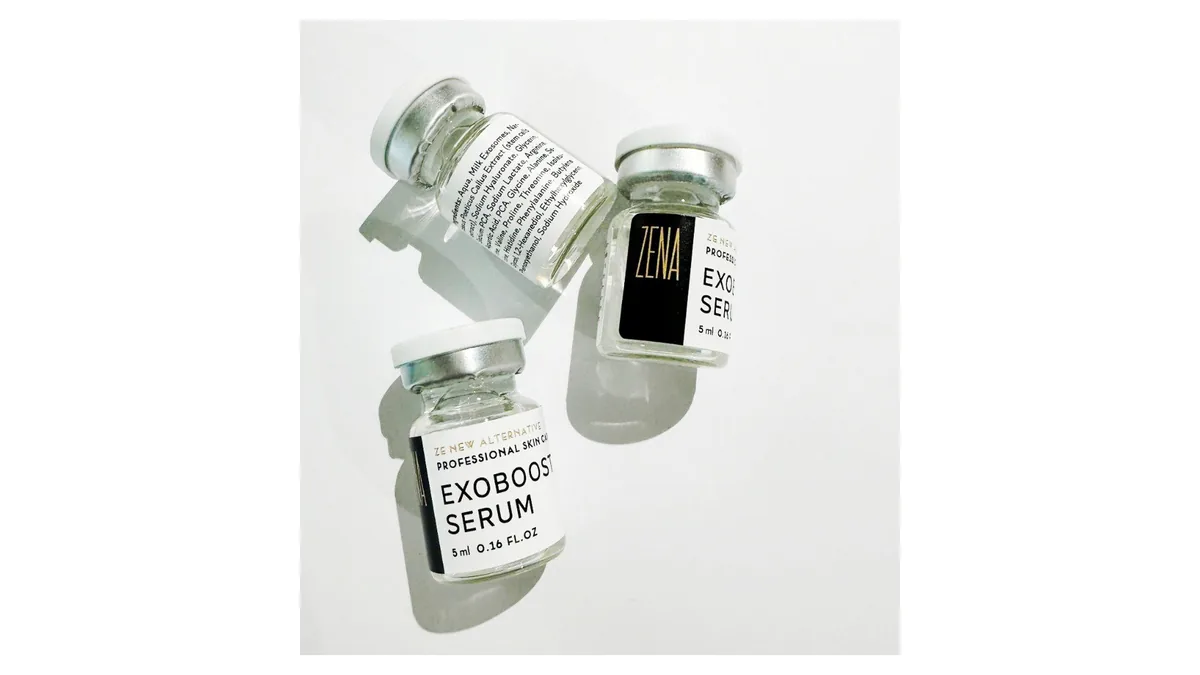
ZENA ExoBoost for professional aesthetic practice
ZENA ExoBoost professional exosome skincare in the UAE is positioned within Glow Derma’s professional portfolio for aesthetic specialists.
It should be presented according to its official product documentation and intended professional protocol. It must not be described as an injectable treatment unless the manufacturer’s authorised instructions specifically support that use.
Aesthetic clinics interested in professional supply, product information or training can contact Glow Derma.
EXOLUME homecare is a separate skincare line
EXOLUME is ZENA’s daily homecare line and should not be confused with the professional ExoBoost product.
The homecare range is designed for a consumer skincare routine, while ExoBoost belongs to the professional side of the portfolio. Keeping this distinction clear helps consumers understand what they can use at home and helps aesthetic professionals maintain an appropriate professional product offering.
Consumers can explore the EXOLUME homecare range.
Can exosome skincare replace professional advice?
No cosmetic skincare article or product should replace individual advice from an appropriately qualified professional.
Persistent pigmentation, inflammation, infection, unexplained lesions or other skin concerns may require medical assessment. Aesthetic practitioners should refer clients when a condition falls outside their scope.
Frequently asked questions
Are exosomes the same as stem cells?
No. Stem cells are living cells. Exosomes are small extracellular vesicles released by cells and are not capable of becoming new cells.
Are plant exosomes real exosomes?
Plants release nanoscale vesicles, but plant-derived vesicle-like particles are not necessarily identical to mammalian-cell-derived exosomes. Product descriptions should identify the source accurately.
Can an exosome serum be injected?
A topical cosmetic should not be injected. Only products specifically authorised for a particular medical route of administration should be used that way, and only by appropriately licensed healthcare professionals.
Can exosome skincare be used after an aesthetic procedure?
That depends on the exact product, procedure, skin condition and manufacturer’s protocol. Professionals should not apply a product to compromised skin simply because it is marketed using exosome terminology.
Does every exosome product provide the same benefits?
No. Source, composition, concentration, purification, stability, packaging and application can all differ. Evidence relating to one formulation should not be used to guarantee the performance of another.
Is exosome skincare scientifically proven?
Extracellular vesicles are a significant area of scientific research, and early findings are encouraging. However, clinical evidence for cosmetic applications is still developing, and claims should be assessed on a product-specific basis.
Final perspective
Exosome science is an exciting and developing field, but responsible skincare communication requires precision.
Professionals should distinguish genuine biological research from broad marketing language, verify the source and intended use of each formulation, and set realistic expectations. Consumers should also understand the difference between daily cosmetic homecare and products supplied for professional aesthetic practice.
Glow Derma supports UAE aesthetic professionals with product education, responsible positioning and access to ZENA’s professional skincare portfolio.
This article is provided for general educational purposes only. It does not constitute medical advice or authorise any product for injection, medical treatment or use outside its official instructions.